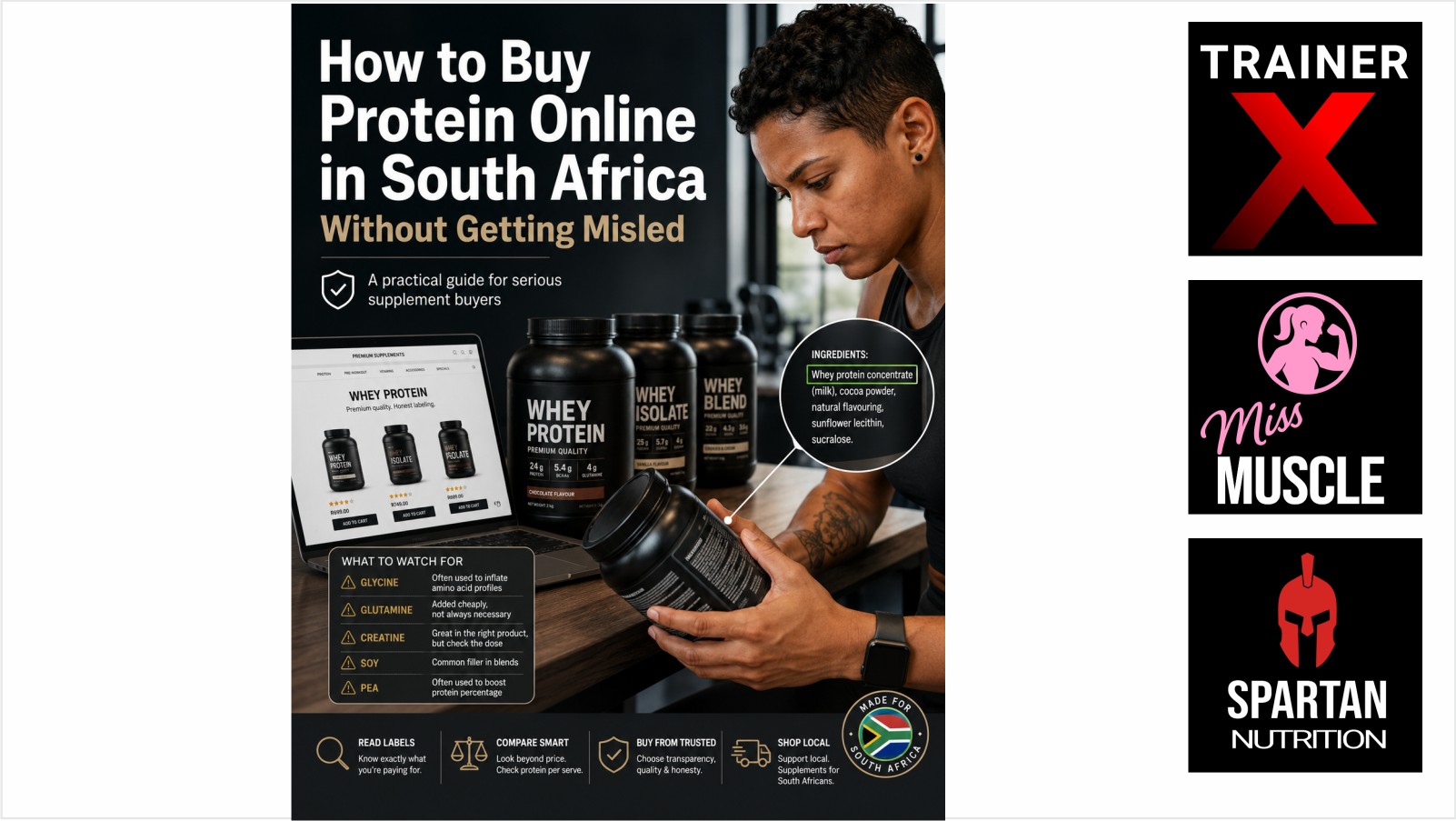
Buying protein online in South Africa sounds simple until you actually start comparing tubs.
One product is cheap. Another is expensive. One says ultra premium. Another says advanced matrix. One has six protein sources. Another has added amino acids. One has a huge number on the front label, but very little clarity once you start reading the ingredients.
For someone serious about training, this is where frustration starts.
You are not just buying a flavour. You are not just buying a container. You are buying something you will use consistently, something that becomes part of your daily food system, part of your recovery, part of your budget, and part of the effort you put into your training.
That is why buying protein online needs more attention than most people give it.
This article is not about attacking brands. It is about helping South African buyers make better decisions when shopping online, especially when all you have to judge from is the label, the price, and the marketing.
When buying protein online, you are not standing alone in the dark unless you let yourself be.
A good online supplement store should make it easy to understand what you are buying, compare products properly, and ask questions before you spend money. In many cases, that can actually be more useful than walking into a store and speaking to someone who is trying to move stock rather than understand your goal.
Online, you should still be able to get clarity.
You are usually looking at:
a product image
a product title
a price
the supplement facts or ingredient list
the product description
and, if the store is serious, a way to ask questions directly
That last part matters.
A serious buyer should be able to ask:
What is this best for?
How do I use it?
Is this the right product for my goal?
What makes this different from the others?
That is why online supplement buying only works properly when the store itself is built around clarity.
If the product page is vague, if the label is unclear, if the ingredients are loaded in a confusing way, or if the whole product is built around hype instead of explanation, the buyer is left guessing.
And in supplements, guessing is expensive.
A serious trainee does not want to keep buying tubs just to find out what works. Most people do not have the money or the patience for that. They want a product that makes sense from the start, and they want access to proper guidance when they need it.
South Africa has a wide supplement market. That sounds good, but it also creates a problem.
The bigger and more commercial the category becomes, the more products are designed to compete for shelf space, price points, and quick attention. That often leads to:
This is where experienced trainees often start getting irritated.
At first, a beginner may be excited by a huge range. But over time, more serious users usually want the opposite. They want fewer choices, clearer logic, and products that are easy to understand.
That is the difference between a general retail shelf and a specialist store.
A general retail shelf tries to serve everyone. A specialist brand tries to make sense to the right person.
That matters online even more, because if your site feels like chaos, people leave.
Amino spiking is easier to understand than it sounds.
If you are buying a whey protein, then the protein in that tub should come mainly from whey protein. That is the whole point. You are paying for protein, not for a label that has been boosted with cheaper extras to make the numbers look better.
Amino spiking happens when cheaper individual amino acids are added to a protein formula in a way that helps increase the total nitrogen reading and makes the product appear stronger than it really is from a protein quality point of view.
In practical terms, this is what the buyer should watch for:
if you are reading a whey protein label and you start seeing added glycine, added glutamine, added creatine, added taurine, or other individual amino acids mixed into the formula, you need to ask why they are there.
Those ingredients can be useful in the right product. Creatine has its place. Glutamine has its place. Glycine has its place. But if you are buying whey protein, you want the value of that tub to come from whey protein, not from cheaper additions that help bulk out the formula or make the protein profile look better than it really is.
That is the red flag.
A tub of glutamine is relatively cheap. Glycine is cheap. Creatine is cheap. So if those are being added into an expensive protein product, the serious question is not whether they sound impressive. The serious question is:
why are they in my protein?
If you are paying for whey, most of the meaningful protein value should be coming from whey itself.
The average buyer may never notice this unless they learn to read labels properly. But once you understand amino spiking, you start seeing why some products look better on paper than they are in practice.us product should not make the buyer work like a detective.
A blend is not automatically bad.
That part must be clear.
Some blends serve a genuine purpose. But many buyers have been trained to assume that more sources always means better quality. That is not necessarily true.
A product that combines whey, soy, pea, rice, and other sources can look very advanced on paper. But often the real reason for the blend is cost management, not performance.
That is where people get misled.
A complex blend can look scientific while actually diluting the value of the main protein source. If a company wants to bring cost down, blending in cheaper proteins is one of the easiest ways to do it.
That is why you should not automatically be impressed by long ingredient lists.
Sometimes a simpler protein is the more honest product.
The serious question is not:
How many protein sources are in here?
The serious question is:
Why were these sources combined in the first place?
If you are buying protein online in South Africa, these are the first things worth checking.
What is doing the real work in the formula?
If it is whey based, that should be clear. If it is a blend, you should be able to understand why. If the product is aimed at muscle support and gym training, the main source should make sense for that purpose.
Ingredients are listed in descending order by weight. That means the early part of the list matters.
Do not just read the front label. Read what appears first in the ingredients.
A good label should be understandable.
If you need to decode every second line, or if the product tries to sound advanced without being clear, that is a warning sign.
A protein can look good on paper and still feel terrible to use.
If it is too heavy, too sickly, too sweet, too bloating, or too unpleasant to drink often, it becomes harder to stay consistent. And consistency matters more than marketing.
Is this a gym protein?
A meal support protein?
A lifestyle protein?
A vegan option?
A recovery support formula?
A serious product should know what job it is doing.
Price matters. Everyone understands that.
But price without context is where people get trapped.
If one tub is cheaper, the first question should not be:
Why is this cheaper?
The better question is:
What had to change inside the tub to make it cheaper?
Sometimes the answer is perfectly fair. Sometimes it is not.
The buyer should compare:
The cheapest tub is not always the best value. The most expensive tub is not always the best either.
Real value sits where quality, purpose, and usability meet.
This is a point people often miss.
The best protein is not only the one with the best numbers. It is the one you can actually use properly in your life.
That means:
A protein that makes daily use harder is not helping your consistency.
And for serious trainees, consistency is where most results come from.
As the supplement market becomes more crowded, more buyers start looking for the same thing:
less noise, more clarity
That is where specialist brands become important.
A specialist brand does not need fifty near-identical tubs to look impressive. It should make the buying process simpler, not harder.
That is one of the reasons serious athletes, long-term lifters, endurance-focused users, and mature buyers often move away from general market clutter over time. They stop chasing whatever is loudest and start choosing what is clearest.
That shift is important for online buying.
Because when you are buying from a screen, clarity becomes trust.
TrainerX was not built to be another endless shelf of confusing products.
It was built around a simple idea:
people who train seriously make serious sacrifices, and the supplements they trust should not let them down
That means the goal is not to overload the range, overload the buyer, or impress people with unnecessary complexity.
The goal is to make products with a clear purpose, clear labelling, and practical logic.
Spartan Nutrition exists for men who take strength and weight training seriously.
MISS Muscle exists for women who lift and want products clearly made with them in mind.
TrainerX supports the wider performance lifestyle around movement, endurance, recovery, and active living.
That is the structure.
Not more noise.
More clarity.
If you are buying protein online in South Africa, do not buy only with your eyes.
Do not buy only from front-label numbers.
Do not buy only from hype.
Do not buy only from price.
Read the product properly.
Ask what the formula is trying to do.
Ask whether the ingredients support that purpose.
Ask whether the product respects your effort, your body, and your money.
That is how serious buyers should shop.
Start with the main protein source, the ingredient list, the clarity of the label, and whether the formula makes practical sense for your goal. A good protein should be easy to understand and easy to use consistently.
No. A blend is not automatically bad. The real issue is why the blend exists. If it serves a clear purpose, that is one thing. If it is mainly there to reduce cost while looking advanced, that is another.
It is when cheaper amino acids are used in a way that can make a protein seem stronger than it really is from a quality point of view. The average buyer may not notice this unless they learn how to read labels properly.
No. Price matters, but it should be judged with context. A cheaper protein may use lower-value sources or less practical formulation choices. Compare what is actually inside the tub, not just the tub price.
Look for clear labels, sensible ingredients, product purpose, digestibility, and whether the site feels trustworthy. Online buyers should be more careful, not less, because they do not have the product physically in front of them.
If you want a simpler way to compare protein online, start by reading the label properly, then browse a range built around clear purpose instead of confusion.
Disclaimer
Information on this site is general and for education only, based on research sources and our opinions, with references for further reading. It is not medical, nutritional, or fitness advice; consult a qualified healthcare practitioner before starting any exercise, diet, supplement, or medication. We make no claims, guarantees, or warranties, and use is at your own risk. Products and supplements mentioned are not intended to diagnose, treat, cure, or prevent any disease.