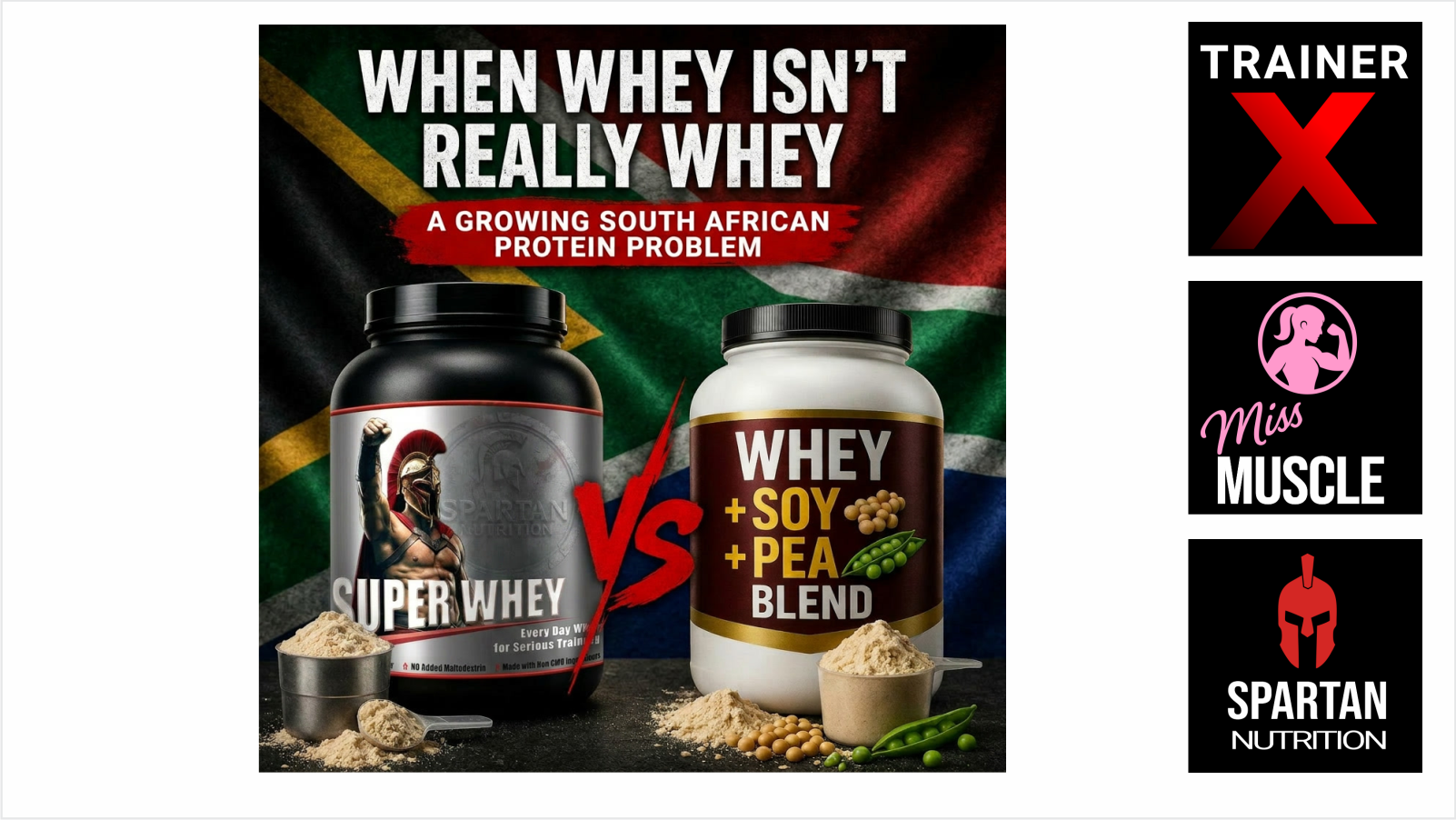
Most people who buy a whey protein are not trying to become experts in protein chemistry.
They are working. They are training. They are trying to lose fat, build muscle, recover better, or simply add a convenient protein source to their day. They see a product that looks like a whey protein, is marketed like a whey protein, sits next to whey proteins, and is priced to compete with whey proteins, so naturally they assume they are buying a whey protein formula.
That is a fair assumption.
The problem is that this is not always what they are getting.
In South Africa, there is a growing pattern where products are positioned in a way that makes consumers think they are buying whey protein, while the formula is actually diluted with cheaper non whey proteins such as soy or pea. The branding is strong. The wording sounds impressive. Terms like blended protein, advanced protein matrix, and multi stage protein are used to make the formula sound more technical or more complete. But behind all the marketing language, the basic question remains very simple:
Is this actually a whey protein formula, or is it a cheaper blend hiding behind whey style marketing?
That is the real issue.
Some people will say protein is protein.
That sounds simple, but it is not accurate in the context of sports nutrition and muscle building.
Not all proteins are equal. Protein quality matters. The amino acid profile matters. Leucine content matters. Digestibility matters. What the body receives from that protein matters.
Whey protein built its reputation for a reason. It is known for a strong essential amino acid profile, high leucine content, and very good usefulness for muscle recovery and muscle protein synthesis. That is why whey protein concentrate and whey protein isolate became the standard for people who train and for people who want a straightforward, high quality protein supplement.
Soy protein and pea protein are different protein sources.
That does not mean they are useless. They have their own place. A properly marketed plant protein product is a separate category and there is nothing wrong with that. If somebody wants a vegan protein, a plant based formula, or a dairy free option, that is a valid choice.
But that is not the same thing as a whey protein formula.
And that is where the problem starts in South Africa. Consumers are often not being given that distinction clearly enough.
A lot of supplement companies behave as if the consumer should have known better.
They will say the ingredients are on the label. They will say the blend is disclosed. They will say the buyer should have read it properly.
That may sound technically fair, but in reality it misses the point.
Most ordinary consumers are not standing in a shop comparing amino acid profiles and protein fractions. They are not industry formulators. They are not all fitness enthusiasts at an advanced level. They are regular people trying to make a better choice for their goals.
They know the word whey.
They know whey is associated with gym nutrition and muscle building.
They know they want protein.
They often compare by price, brand, flavour, and the protein grams on the label.
So when a product is presented in a way that strongly suggests whey, the consumer should not be blamed for assuming it is mainly whey.
That assumption is exactly what the market is taking advantage of.
A whey protein formula should be built on whey protein.
That means the core protein system should come from whey protein concentrate, whey protein isolate, or a combination of the two.
Once a formula starts using soy protein, pea protein, or other cheaper non whey proteins to bring the cost down, it is no longer a straightforward whey protein formula. It is now a blend.
That blend may still contain whey.
It may still deliver protein.
It may still have a place in the market.
But it is not the same thing.
And it should not be sold in a way that makes ordinary buyers think they are getting the same quality, same protein type, or same functional value as a real whey protein formula.
The answer is simple.
Cost.
Whey protein is expensive. High quality dairy proteins cost money. If a company can reduce some of that whey content and replace it with cheaper proteins like soy or pea, it can reduce the cost of the formula. That allows the brand to compete harder on price, increase its margins, or both.
Then the marketing comes in.
Instead of saying clearly that the product is a lower cost mixed protein formula, the language becomes vague and polished. It becomes a protein matrix. A premium blend. A multi source system. A sustained release approach. A scientifically designed combination.
The names sound advanced, but often the real purpose is much simpler: reduce cost without making the product look cheap.
That is why this has become a real South African protein problem.
The word blended is often used as if it adds value by itself.
It does not.
A blend is not automatically superior just because it contains more than one protein source. In many cases, blending is simply a cost control strategy. It allows a company to use less of the expensive protein and more of the cheaper protein while still keeping the total protein grams high enough to look attractive.
From a marketing point of view, that works very well.
From an education point of view, it creates confusion.
Consumers start thinking that a blended formula must be more advanced, more complete, or more intelligent than a straightforward whey protein. But that is often not the case. Sometimes it is simply a more economical way to formulate a product while still borrowing the image and reputation of whey.
That is why the wording matters so much.
For muscle building and recovery, protein is not just about the total number of grams on the label.
It is about the quality of those grams.
A protein with a stronger amino acid profile, especially a strong essential amino acid and leucine profile, is not the same as a cheaper blend that only reaches the same total protein number by combining weaker or less suitable protein sources.
This is where many consumers get misled.
They compare one product to another and see similar protein grams per serving. On paper, that can make the products look comparable. But if one product is built on real whey protein and the other is partly built on soy or pea to lower cost, those are not identical products in practical use.
The label number may look similar.
The formula quality may not be.
That is why not all proteins are equal.
This point needs to be clear.
There is nothing wrong with soy protein when it is sold honestly as soy protein.
There is nothing wrong with pea protein when it is sold honestly as pea protein.
There is nothing wrong with a plant protein blend when it is sold clearly as a plant protein blend.
Those are separate categories, and people can choose them for their own reasons.
The issue is not that plant proteins exist.
The issue is when plant proteins are used inside products that rely on the name, look, or reputation of whey to make the formula seem like something it is not.
That is where the line gets crossed.
When someone is trying to lose fat, build muscle, improve recovery, or simply make better nutrition choices, they should not have to fight through misleading protein marketing at the same time.
People are already putting in effort. They are spending money. They are trying to improve themselves. The last thing they need is to be quietly pushed toward a lower grade formula while believing they are buying a proper whey protein.
That undermines trust.
And once trust is damaged, the whole category becomes harder for consumers to navigate.
This is why education matters.
Not because everyone needs to become a supplement expert.
But because everyone deserves to understand what they are buying.
The first thing to look at is the actual protein sources in the ingredient list.
If the product is presented like a whey protein, ask a very simple question:
Is the protein actually coming mainly from whey protein concentrate and whey protein isolate, or has it been diluted with soy, pea, or other cheaper proteins?
That one question clears up a lot.
If it is a blend, it should be called a blend.
If it is a plant protein, it should be called a plant protein.
If it is a whey protein, it should actually be whey protein.
That is not extreme.
That is just honest labelling.
We believe consumers should be able to trust what the product appears to be.
If a product is sold as whey, it should be a real whey protein formula.
If a brand wants to sell a blend, then it should clearly say it is a blend.
If a brand wants to sell plant protein, then it should clearly say that too.
In our case, we do not use soy or pea to dilute whey formulas. We keep the distinction clear because the category should be clear.
That matters to us because consumers should not have to decode clever wording just to understand what is in the tub.
This article is not written to attack people for what they buy.
It is written to help people understand what they are buying.
If a consumer reads this and still chooses a blended product because it suits their budget, preferences, or needs, that is their choice. There is nothing wrong with making an informed decision.
The problem is not choice.
The problem is confusion.
And right now, confusion around whey protein versus cheaper blended protein formulas is becoming a real South African market problem.
Consumers deserve clarity.
They deserve honesty.
And when they buy whey, they should not have to wonder whether it is really whey.
Disclaimer
Information on this site is general and for education only, based on research sources and our opinions, with references for further reading. It is not medical, nutritional, or fitness advice; consult a qualified healthcare practitioner before starting any exercise, diet, supplement, or medication. We make no claims, guarantees, or warranties, and use is at your own risk. Products and supplements mentioned are not intended to diagnose, treat, cure, or prevent any disease.