There comes a point where fitness is no longer about chasing the body you could have built at 25, 30, or even 35. For most men, that point is 50.
By then, life has already happened. Work happened. Family happened. Responsibilities happened. Time moved. Maybe you trained on and off. Maybe you never had the chance to do it properly. Maybe you always thought you would get serious later.
Then later arrives.
At 50, the conversation has to change. The goal is no longer to fantasize about becoming the man you could have been twenty years ago. The goal now is to build the best body you still can from where you are, and more importantly, to prepare for how you want to live at 60, 65, and beyond.
That is where most fitness advice gets it wrong. It still speaks to men over 50 as if they are just late starters in a young man’s system. They are not. Fifty is different. The approach has to be different too.
At 50, time is no longer something you can ignore. That is not negativity. That is reality.
If you delayed training through your 20s, 30s, and 40s, you cannot approach fitness now as if you have endless years to experiment, waste time, or restart over and over. You do not. That is exactly why your training needs to become smarter.
This is where many men go wrong. They still think in terms of dramatic transformations, gym based identities, and unrealistic body goals that belonged to a different stage of life. They think the answer is to sign up for a contract, throw themselves into hard sessions, and try to force the body into a result that may no longer be the best use of their time or energy.
That does not mean progress is impossible. It means optimization matters more.
At 50, the question is not, “How do I train like a 28 year old?”
The question is, “How do I train in a way that gives me the best return now?”
That means better movement, better strength, better control, better body composition, better daily energy, and a body that is more capable five and ten years from now.
This is where honesty matters.
If you never built a certain physique in your younger years, trying to chase it at 50 is often a poor use of time. Not impossible in every case, but poor in terms of efficiency, sustainability, and return on effort.
A lot of men do not need more motivation. They need a more intelligent target.
For some men, that target is fat loss.
For some, it is getting stronger.
For others, it is moving without stiffness, getting off the floor more easily, carrying less body fat, feeling more athletic, or maintaining muscle and confidence as they age.
That is the shift.
Fitness at 50 is no longer mainly about building an image.
It is about building a future.
Most mainstream fitness systems are built on friction.
Drive to the gym.
Wait for equipment.
Do a generic plan.
Push through movements that may not suit your structure.
Repeat until motivation drops.
That may work for some people, especially earlier in life. But for men over 50, that model often breaks down quickly. It demands too much time, too much inconvenience, and too much unnecessary complexity.
At this age, consistency matters more than intensity theatre.
That is why the better approach is low friction training.
You do not need more obstacles. You need fewer.
You need a method that fits into your real life. A method that works at home, in your office, outdoors, while traveling, or even during a short break in the day. A method where you know exactly what to do, how to do it, and why you are doing it.
That is what creates adherence.
That is what creates momentum.
That is what creates long term results.
One of the biggest myths in fitness is that progress needs a full gym environment.
It does not.
What most men over 50 need is not more equipment. They need competence with simple tools.
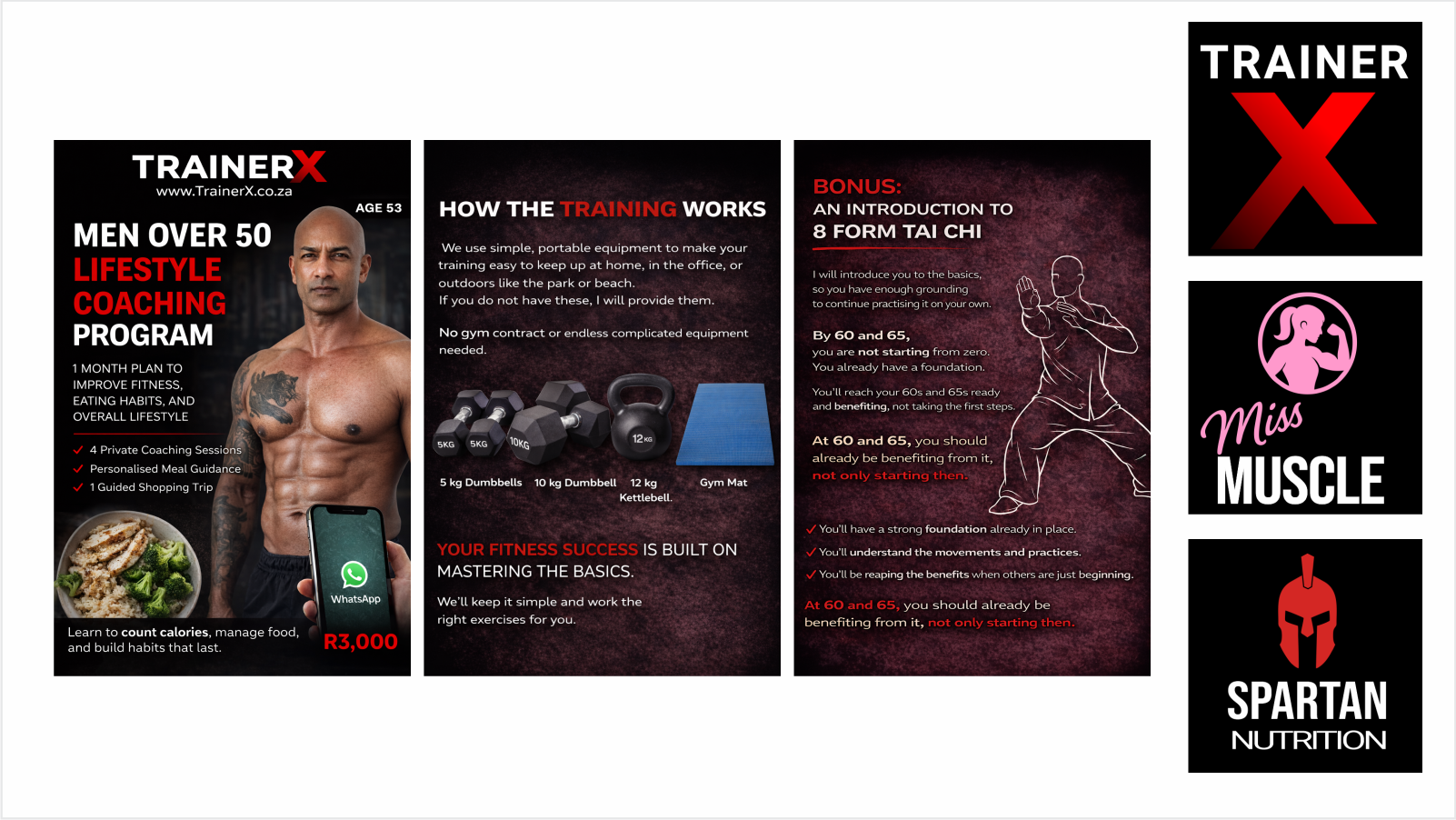
A few well chosen pieces of equipment can take you very far when you know how to use them properly. In this system, the focus is on making you confident and proficient with simple, practical tools that can be used almost anywhere.
That means:
A 5 kg dumbbell
A 10 kg dumbbell
A 12 kg kettlebell
A gym mat
That is enough to build a powerful foundation.
This is equipment you can use at home, in an office, at a park, while away on holiday, or in a small gym. It removes excuses. It removes the dependency on a facility. It removes the idea that fitness only happens when conditions are perfect.
And that matters, because at 50, perfect conditions are rare. Real life is what you have.
The simpler the system, the easier it is to repeat.
The easier it is to repeat, the more likely it becomes a habit.
And once it becomes a habit, the results follow.
That is the real strategy.
You are not trying to impress anyone.
You are trying to build a routine you can actually live with.
If you have twenty minutes and know exactly what to do, you are in a far better position than the man who keeps waiting for the perfect gym schedule, the perfect program, the perfect motivation, or the perfect Monday.
Low friction training means the barrier to action is low.
You are not thinking about traffic, parking, access cards, crowds, or whether the gym is open. You are thinking about execution.
That is one of the biggest differences between fantasy fitness and practical fitness.
The point of this coaching model is not to make you dependent on sessions forever.
The point is to make you capable.
That means teaching you how to use dumbbells properly, how to use kettlebells effectively for what you need, how to train with control, and how to build confidence in a small number of movements that actually matter.
Once you master a few exercises, you can build on them logically. That is how real progress happens.
Not through endless variety.
Not through confusion.
Not through being overwhelmed.
Through repetition, refinement, and confidence.
That is how the program is structured. I make you proficient in the tools, the movements, and the method, so that you can continue with clarity even outside of the sessions.
This is not about entertainment.
It is about competence.
There is a difference between activity and strategy.
A lot of personal training and transformation style programs are built around activity. Sessions are hard. Sweat is high. Fatigue feels productive. The client feels they have done something.
But that is not the same as building a plan that is optimized for a man over 50.
Trying to start squatting heavy, deadlifting conventionally, or forcing yourself into movements you never built competence in over the years may not be impossible, but it is often inefficient. It is not always the smartest use of time, recovery, or risk.
At 50, you do not need to prove how hard you can train.
You need to prove how well you can train.
That means choosing movements and tools that deliver return without unnecessary complication. It means thinking like an executive, not like a teenager. It means understanding that optimization matters.
If you come from an academic or executive background, this should make immediate sense. You already understand leverage, efficiency, and the cost of wasting time. Fitness should be treated the same way.
As a bonus, I introduce clients to the basics of 8 Form Tai Chi.
Not to make them masters in a few sessions.
Not to turn the program into a Tai Chi course.
And not as a gimmick.
The purpose is much more practical than that.
It is to give you enough grounding that you can continue exploring it on your own, and so that by 60 and 65 you are not starting from zero. You already have a foundation. You already know something of value. You already have a movement practice that supports your future.
That is what future proofing means.
Too many people wait until later to prepare for later. Then later arrives, and they are ten steps behind. That is exactly what this whole philosophy is designed to avoid.
By introducing Tai Chi now, even at a basic level, you start laying down another layer of long term capability. Something you can carry forward. Something that fits the same overall strategy of longevity, control, and preparedness.
This is not fitness for show.
This is fitness for the years ahead.
At this age, the priority list changes.
You should be training for:
Strength that helps you in real life
Movement that feels smoother and safer
Better body composition over time
Control over your own body
Confidence with simple equipment
Habits you can actually maintain
Vitality into your 60s and beyond
That is the real target.
Not a rushed before and after.
Not a dramatic challenge.
Not another cycle of starting and stopping.
The goal is to become harder to break down.
At 50, the worst thing you can do is waste more time on the wrong system.
You do not need more noise.
You do not need more complication.
You do not need another generic plan built for people in a completely different stage of life.
You need a method that respects where you are now, works with your real schedule, removes friction, and prepares you for the future.
That is what this approach is about.
Build from where you are.
Train with purpose.
Keep it simple.
And start preparing now for the body you will be living in at 60, 65, and beyond.
No. The whole point is to reduce friction. The program is designed around simple equipment and practical training you can do at home, at work, outdoors, or while traveling.
At the most basic level, a 5 kg dumbbell, a 10 kg dumbbell, a 12 kg kettlebell, and a gym mat are enough to build a very effective system.
No. It is not too late to improve. But it is the wrong time to waste effort on unrealistic or poorly optimized methods. The aim is to improve intelligently from where you are now.
Because this is about future proofing. The Tai Chi introduction gives you enough grounding to continue learning and benefiting from it over time, instead of only discovering it much later when you need it even more.
Not in the traditional sense. It is lifestyle based fitness coaching designed to make you competent, confident, and consistent with a method that fits your age, goals, and reality.
If you are over 50 and tired of generic fitness advice, complicated systems, and wasted time, this approach was built for you.
Send me a message and let us build something practical, intelligent, and sustainable for the years ahead.
Disclaimer
Information on this site is general and for education only, based on research sources and our opinions, with references for further reading. It is not medical, nutritional, or fitness advice; consult a qualified healthcare practitioner before starting any exercise, diet, supplement, or medication. We make no claims, guarantees, or warranties, and use is at your own risk. Products and supplements mentioned are not intended to diagnose, treat, cure, or prevent any disease.